The Planets

  • Planets
    • Mercury
    • Venus
    • Earth
    • Mars
    • Jupiter
      • Jupiter Red Spot
    • Saturn
    • Uranus
    • Neptune
  • Solar System
    • Dwarf Planets
      • Ceres
      • Pluto
      • Haumea
      • Makemake
      • Eris
      • Sedna
    • Moons
      • Moons of Saturn
      • Moons of Jupiter
    • The Sun
    • The Moon
      • New Moon
      • Waxing Gibbous Moon
      • First Quarter Moon
      • Waxing Crescent Moon
      • Full Moon
      • Lunar Eclipses
    • Asteroid Belt
    • The Heliopause
    • Kuiper Belt
    • Oort Cloud
    • Solar Eclipses
  • Objects
    • Asterisms
    • Asteroids
    • Comets
    • Constellations
    • Gas Giants
    • Meteorites
    • Meteor Showers
    • Stars
      • Star Clusters & Clouds
      • Types Of Stars
    • Terrestrial Planets
  • Galaxies
    • Black Holes
    • Andromeda
    • Antennae
    • Centaurus A
    • The Milky Way
    • Magellanic Clouds
    • Pinwheel
    • Sombrero
    • Triangulum
    • Whirlpool
    • Types Of Galaxies
    • Superclusters
  • Tools
    • Your Weight on Other Planets
    • Your Age on Other Planets
    • Calculate Distances Between Planets
    • Interactive Solar System Model
  • Questions

Does The Sun Rotate?

DOES SUN ROTATE?

The rotation of Earth and other planets in our solar system is relatively easy to keep track of. Here on Earth, a full rotation takes 24 hours, which creates our day/night cycle. While our planet’s rotation tends to stay constant, the same can’t be said for the sun.

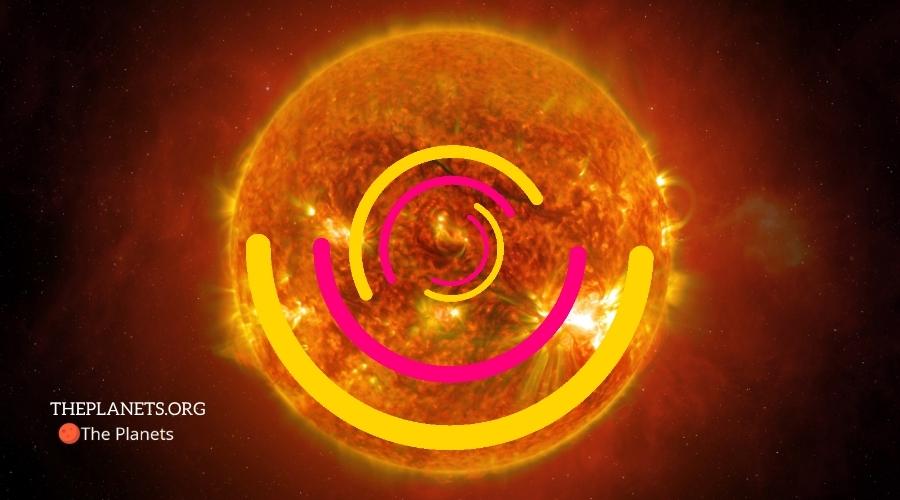
The sun does rotate. However, it does so in a much different way. Unlike the moon or Earth, the sun does not have a hard outer layer. It’s predominantly made of hydrogen and helium. Gases and plasmas can react much differently to rotational spin than solid rock does.

The sun’s surface, for example, has many different rates of rotation. At the equator, the sun takes approximately 27 days to complete a full rotation on its axis. Yet, at the poles, it takes about 35 days. That’s a full 12 days more! This fluid rotation gets even more complex in between. Generally speaking, the farther away you get from the equator, the slower the spin.

As if that weren’t confusing enough, the sun is made up of many different layers. Each layer has its own independent rotation speeds. Scientists believe that the inner-most layer behaves more predictably than the fluid outer layer. To put it simply, the inner layer moves as one without any fluctuations based on distant from the center. However, this layer moves at a much faster rate.

So, with all of this unpredictable movement, how do scientists keep track of the sun’s rotation? Well, they use the same method that Galileo did when he first discovered that the gaseous sun rotated back in 1612. Sunspots on the surface of the sun can be used to monitor the outer layer’s movement.

Sunspots are visible cold areas. They’re still several thousand degrees hot, but in relation to the rest of the sun, they’re considerably cooler. They are caused by plasma interacting with the sun’s magnetic field. Because of the temperature drop, sunspots take on a dark color that easily stands out against the sun’s orange hue. Plus, they often cause solar storms and flares.

While the sun’s rotational pattern seems a bit confusing and disorderly, it serves an important function. The faster spin in the inner layers of the sun causes radiation to move towards the outer plasma layers. It’s thought that this action is what creates the sun’s magnetic field.

Link/cite this page

If you use any of the content on this page in your own work, please use the code below to cite this page as the source of the content.

  • <a href="https://theplanets.org/does-the-sun-rotate/">Does The Sun Rotate?</a>

  • Stewart, Suzy. "Does The Sun Rotate?". The Planets. Accessed on April 16, 2026. https://theplanets.org/does-the-sun-rotate/.

  • Stewart, Suzy. "Does The Sun Rotate?". The Planets, https://theplanets.org/does-the-sun-rotate/. Accessed 16 April, 2026.

  • Stewart, Suzy. Does The Sun Rotate?. The Planets. Retrieved from https://theplanets.org/does-the-sun-rotate/.

Search The Universe

Popular Posts

  • Space Facts
  • Planet Facts
  • Sun Facts
  • Moon Facts
  • Types of Galaxy
  • Star Facts

Facts About The Eight Planets

  • Facts About Mercury
  • Facts About Venus
  • Facts About Earth
  • Facts About Mars
  • Facts About Jupiter
  • Facts About Saturn
  • Facts About Uranus
  • Facts About Neptune
  • About Us
  • Contact Us

More Posts from General

  • What Is The Coldest Planet?
  • Where Are The Space Shuttles Now?
  • How long would it take to get to Venus?
  • How long would it take to get to Mercury?
  • How long would it take to get to Mars?
  • What Is A Wolf Moon?
  • What Is A Shooting Star?
  • What is a Nova?
  • What is Cosmic Microwave Background Radiation (CMBR)?
  • How Many Earths Can Fit Into Jupiter?

© The Planets 2010 - 2026 | Privacy Policy & Affiliate Disclaimer

Copyright © 2026 ThePlanets.org | Sitemap